
Preparing for the USMLE Step 1 requires a strong command of microbiology, especially high-yield organisms, toxins, and clinical correlations.
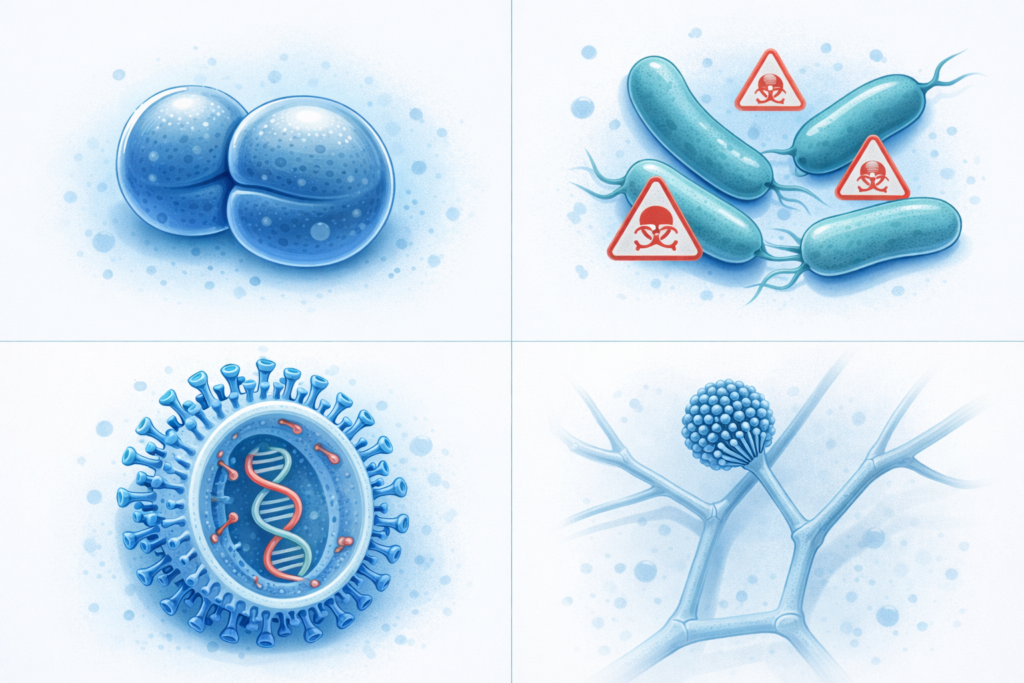
This page features 25 USMLE-style microbiology questions with clear explanations, covering bacteria, viruses, fungi, and parasites frequently tested on exam day. Each question is designed to mirror real USMLE concepts and help reinforce rapid clinical decision-making.
USMLE Microbiology Questions with Explanations (25 High-Yield MCQs)
Question 1
A 22-year-old college student presents with fever, headache, and neck stiffness. CSF shows increased neutrophils and decreased glucose. Gram stain reveals gram-negative diplococci. What is the most important virulence factor?
A) Protein A
B) Capsule
C) Exotoxin A
D) Lipoteichoic acid
Answer: B) Capsule
Explanation:
This is Neisseria meningitidis. The polysaccharide capsule prevents phagocytosis and is the key virulence factor.
Question 2
A patient develops bloody diarrhea after eating undercooked ground beef. Stool culture shows sorbitol-negative gram-negative rods. Mechanism of disease?
A) Heat-stable toxin
B) Shiga-like toxin inhibiting 60S ribosome
C) Invasion of Peyer patches
D) cAMP activation
Answer: B) Shiga-like toxin inhibiting 60S ribosome
Explanation:
This is EHEC (O157:H7). It produces Shiga-like toxin that inhibits the 60S ribosomal subunit → HUS risk.
Question 3
A child presents with barking cough and inspiratory stridor. Cause?
A) RSV
B) Parainfluenza virus
C) Influenza
D) Adenovirus
Answer: B) Parainfluenza virus
Explanation:
Parainfluenza causes croup (laryngotracheobronchitis).
Question 4
A patient with HIV has pneumonia. Silver stain shows cup-shaped cysts. Organism?
A) Histoplasma
B) Cryptococcus
C) Pneumocystis jirovecii
D) Aspergillus
Answer: C) Pneumocystis jirovecii
Question 5
Which organism produces alpha toxin that destroys cell membranes?
A) Bacillus anthracis
B) Clostridium perfringens
C) Clostridium tetani
D) Listeria monocytogenes
Answer: B) Clostridium perfringens
Explanation:
Alpha toxin is a lecithinase causing gas gangrene.
Question 6
A patient develops ascending paralysis after eating improperly canned food. Mechanism?
A) Blocks acetylcholine release
B) Blocks glycine release
C) Stimulates acetylcholine release
D) Destroys Schwann cells
Answer: A) Blocks acetylcholine release
Explanation:
Botulinum toxin prevents ACh release → flaccid paralysis.
Question 7
Which virus integrates into host DNA using reverse transcriptase?
A) Influenza
B) HIV
C) HSV
D) CMV
Answer: B) HIV
Question 8
A painless genital ulcer with indurated edges. Diagnosis?
A) HSV
B) Syphilis
C) Chancroid
D) Gonorrhea
Answer: B) Syphilis
Explanation:
Treponema pallidum causes painless chancre.
Question 9
Most common cause of atypical pneumonia in young adults?
A) Streptococcus pneumoniae
B) Mycoplasma pneumoniae
C) Klebsiella
D) Legionella
Answer: B) Mycoplasma pneumoniae
Question 10
Which organism grows on Thayer-Martin agar?
A) N. meningitidis
B) N. gonorrhoeae
C) E. coli
D) H. influenzae
Answer: B) N. gonorrhoeae
Question 11
A patient develops pseudomembranous colitis after antibiotics. Toxin mechanism?
A) Inhibits EF-2
B) Activates adenylate cyclase
C) Inactivates Rho GTPases
D) Blocks 60S ribosome
Answer: C) Inactivates Rho GTPases
Explanation:
C. difficile toxin damages cytoskeleton → colitis.
Question 12
Which organism has a polysaccharide capsule detected by India ink?
A) Candida
B) Histoplasma
C) Cryptococcus neoformans
D) Aspergillus
Answer: C) Cryptococcus
Question 13
Which bacterium is urease positive and associated with peptic ulcers?
A) Campylobacter
B) H. pylori
C) Vibrio cholerae
D) Salmonella
Answer: B) H. pylori
Question 14
A patient with splenectomy is most at risk for infection with:
A) Gram-positive rods
B) Encapsulated organisms
C) Anaerobes
D) Mycobacteria
Answer: B) Encapsulated organisms
Question 15
Which virus causes Koplik spots?
A) Rubella
B) Measles
C) Varicella
D) EBV
Answer: B) Measles
Question 16
A rusty sputum pneumonia suggests:
A) Klebsiella
B) Staph aureus
C) Strep pneumoniae
D) Pseudomonas
Answer: C) Strep pneumoniae
Question 17
Which organism causes rice-water diarrhea?
A) ETEC
B) Vibrio cholerae
C) Shigella
D) Salmonella
Answer: B) Vibrio cholerae
Question 18
Which bacteria is acid-fast?
A) Listeria
B) Mycobacterium tuberculosis
C) Nocardia (partial)
D) Both B and C
Answer: D) Both B and C
Question 19
A patient has bull’s-eye rash after tick bite. Organism?
A) Rickettsia
B) Borrelia burgdorferi
C) Babesia
D) Ehrlichia
Answer: B) Borrelia burgdorferi
Question 20
Which fungus forms hyphae branching at 45 degrees?
A) Mucor
B) Candida
C) Aspergillus
D) Histoplasma
Answer: C) Aspergillus
Question 21
A newborn develops conjunctivitis 5 days after birth. Cause?
A) HSV
B) Gonorrhea
C) Chlamydia
D) CMV
Answer: C) Chlamydia
Question 22
Which parasite causes macrocytic anemia?
A) Giardia
B) Entamoeba
C) Diphyllobothrium latum
D) Toxoplasma
Answer: C) Diphyllobothrium latum
Question 23
Which virus causes fifth disease?
A) Parvovirus B19
B) CMV
C) HHV-6
D) EBV
Answer: A) Parvovirus B19
Question 24
Which bacteria produces superantigen toxin causing toxic shock syndrome?
A) Streptococcus pyogenes
B) Staph aureus
C) Both A and B
D) Clostridium
Answer: C) Both A and B
Question 25
Which organism is oxidase positive and produces blue-green pigment?
A) E. coli
B) Pseudomonas aeruginosa
C) Klebsiella
D) Proteus
Answer: B) Pseudomonas aeruginosa
Related articles
- usmle step 2 ck practice questions with answers
- USMLE Step 1 Glomerulonephritis Pathology Questions
- usmle step 1 practice questions with explanations free
❓ Frequently Asked Questions
Q1. Are microbiology questions high yield for USMLE Step 1?
Yes. Microbiology is heavily tested, especially toxins, virulence factors, and classic clinical scenarios.
Q2. Is this content suitable for international medical graduates (IMGs)?
Yes. These questions follow standard USMLE exam patterns used for both US and international candidates.
Q3. How many microbiology questions appear on USMLE Step 1?
Microbiology accounts for a significant portion of infectious disease and pathology questions across multiple systems.