
Glomerulonephritis is one of the most heavily tested renal pathology topics on USMLE Step 1, frequently integrated with immunology, microbiology, and pathology. Questions often test your ability to recognize clinical presentation, immunofluorescence patterns, and electron microscopy findings.
On this page, you’ll find 20 high-yield USMLE Step 1 glomerulonephritis pathology questions, designed to mirror NBME-style exam logic. Each question emphasizes classic buzzwords, diagnostic clues, and board-relevant mechanisms that repeatedly appear on Step 1.
This resource is ideal for:
- Dedicated Step 1 study
- Renal pathology revision
- Rapid pre-exam review
🔹 Why Glomerulonephritis Is High-Yield on Step 1
✅ Core Reasons
- Direct testing of immunopathology
- Easy to integrate with clinical vignettes
- Clear visual patterns (IF + EM)
- High overlap with NBME & UWorld
✅ Commonly Tested Associations
- PSGN → Strep + low complement
- IgA nephropathy → synpharyngitic hematuria
- MPGN → tram-track GBM
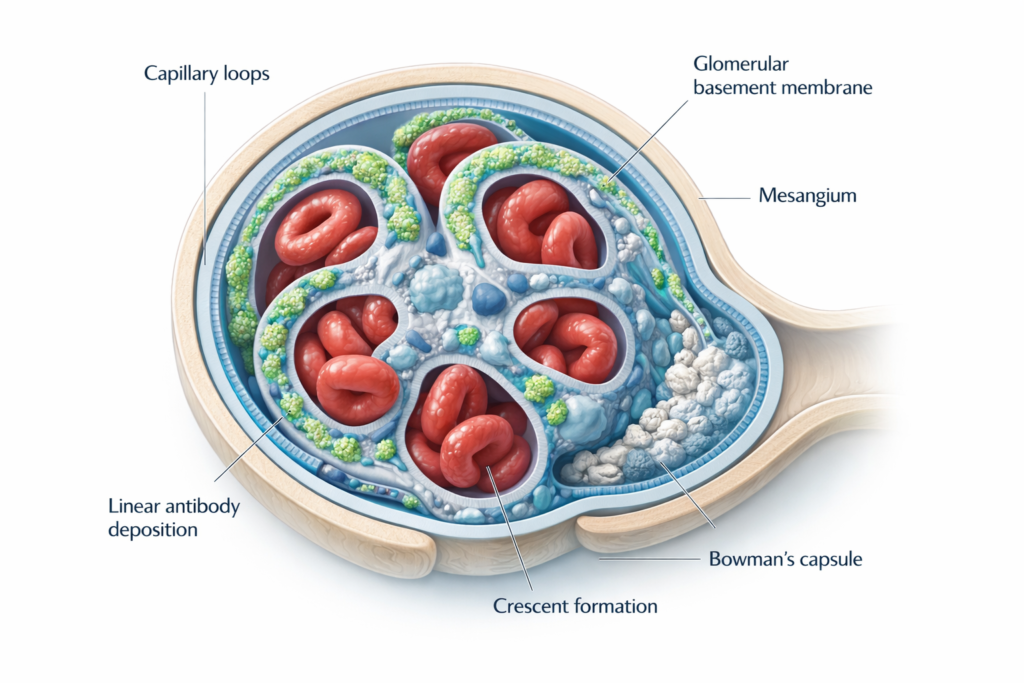
- Goodpasture → linear IgG
- RPGN → crescents
🔹 How to Approach GN Questions on USMLE Step 1
Step-wise Strategy:
- Identify timing (post-infection vs immediate)
- Determine nephritic vs nephrotic
- Look for IF pattern (granular vs linear vs pauci-immune)
- Confirm with EM finding
- Match with classic association
📌 Most wrong answers come from confusing IF patterns, not lack of knowledge.
USMLE Step 1 Glomerulonephritis Pathology – 20 High-Yield MCQs
Question 1
A 7-year-old boy presents with periorbital edema and cola-colored urine 2 weeks after a sore throat. Labs show elevated ASO titers. What is the expected finding on immunofluorescence?
A) Linear IgG deposition
B) Granular IgG and C3 deposition
C) Mesangial IgA deposition
D) No immune complex deposition
Answer: B) Granular IgG and C3 deposition
Explanation:
This is post-streptococcal glomerulonephritis (PSGN). Immune complexes deposit in the glomerulus producing a “lumpy-bumpy” granular pattern on IF.
Question 2
A patient presents with hematuria occurring within 1 day of a respiratory infection. What is the most likely diagnosis?
A) PSGN
B) IgA nephropathy
C) Membranous nephropathy
D) FSGS
Answer: B) IgA nephropathy
Explanation:
Hematuria occurring within days of URI is classic for IgA nephropathy (Berger disease) due to mesangial IgA deposition.
Question 3
Which glomerulonephritis shows a “tram-track” appearance on light microscopy?
A) Minimal change disease
B) Membranous nephropathy
C) Membranoproliferative GN
D) FSGS
Answer: C) Membranoproliferative GN
Explanation:
MPGN shows mesangial proliferation with GBM splitting → tram-track appearance.
Question 4
A patient with SLE develops nephritic syndrome. What is the underlying mechanism?
A) Anti-GBM antibodies
B) Immune complex deposition
C) Podocyte effacement
D) ANCA-mediated vasculitis
Answer: B) Immune complex deposition
Explanation:
Lupus nephritis is a type III hypersensitivity reaction with immune complex deposition.
Question 5
Linear IgG deposition along the GBM is seen in:
A) IgA nephropathy
B) Goodpasture syndrome
C) PSGN
D) MPGN
Answer: B) Goodpasture syndrome
Explanation:
Anti-GBM antibodies produce linear immunofluorescence pattern.
Question 6
Which condition is most strongly associated with hepatitis B infection?
A) Minimal change disease
B) Membranous nephropathy
C) IgA nephropathy
D) Rapidly progressive GN
Answer: B) Membranous nephropathy
Explanation:
Membranous nephropathy is associated with HBV, SLE, and solid tumors.
Question 7
Rapidly progressive glomerulonephritis (RPGN) is characterized by:
A) Subepithelial humps
B) Crescent formation
C) Mesangial IgA
D) Podocyte fusion only
Answer: B) Crescent formation
Explanation:
RPGN causes severe glomerular injury leading to crescent formation from fibrin leakage.
Question 8
Which glomerulonephritis is most common in children with nephrotic syndrome?
A) FSGS
B) Membranous nephropathy
C) Minimal change disease
D) MPGN
Answer: C) Minimal change disease
Explanation:
Minimal change disease is the most common cause of nephrotic syndrome in children.
Question 9
Electron microscopy of membranous nephropathy shows:
A) Subepithelial immune deposits
B) Subendothelial deposits
C) Mesangial deposits
D) No deposits
Answer: A) Subepithelial immune deposits
Question 10
Focal segmental glomerulosclerosis primarily affects:
A) All glomeruli diffusely
B) Some glomeruli partially
C) Only mesangium
D) Tubules only
Answer: B) Some glomeruli partially
Explanation:
“Focal” = some glomeruli
“Segmental” = part of glomerulus
Question 11
Which GN is strongly associated with HIV?
A) Minimal change
B) FSGS
C) PSGN
D) IgA nephropathy
Answer: B) FSGS
Question 12
Low complement levels are most commonly seen in:
A) IgA nephropathy
B) PSGN
C) Minimal change disease
D) FSGS
Answer: B) PSGN
Question 13
Podocyte foot process effacement without immune deposits suggests:
A) Membranous nephropathy
B) Minimal change disease
C) MPGN
D) Goodpasture
Answer: B) Minimal change disease
Question 14
A patient has pulmonary hemorrhage and hematuria. Diagnosis?
A) ANCA vasculitis
B) Goodpasture syndrome
C) PSGN
D) Lupus nephritis
Answer: B) Goodpasture syndrome
Question 15
Which GN is most common worldwide?
A) PSGN
B) IgA nephropathy
C) Membranous
D) FSGS
Answer: B) IgA nephropathy
Question 16
“Spike and dome” appearance is seen in:
A) MPGN
B) Membranous nephropathy
C) Minimal change
D) IgA nephropathy
Answer: B) Membranous nephropathy
Question 17
Which is nephritic in presentation?
A) Minimal change
B) Membranous
C) PSGN
D) FSGS
Answer: C) PSGN
Question 18
ANCA-associated vasculitis typically shows:
A) Granular IF
B) Linear IF
C) No immune deposits (pauci-immune)
D) Mesangial IgA
Answer: C) No immune deposits
Question 19
Which GN has subendothelial deposits?
A) MPGN
B) Minimal change
C) Membranous
D) FSGS
Answer: A) MPGN
Question 20
The primary immune cell responsible for crescent formation in RPGN is:
A) Neutrophil
B) Macrophage
C) B cell
D) Podocyte
Answer: B) Macrophage
Explanation:
Crescents form from fibrin leakage and macrophage proliferation in Bowman space.
| Disease | IF Pattern | EM Finding | Clinical Type |
|---|---|---|---|
| PSGN | Granular | Subepithelial humps | Nephritic |
| IgA | Mesangial IgA | Mesangial deposits | Nephritic |
| Goodpasture | Linear | Anti-GBM | Nephritic |
| MCD | Negative | Podocyte effacement | Nephrotic |
| Membranous | Granular | Spike & dome | Nephrotic |
| FSGS | Negative | Segmental sclerosis | Nephrotic |
| MPGN | Granular | Subendothelial | Mixed |
🔹 Common USMLE Traps (EXAM GOLD)
- ❌ PSGN ≠ IgA (timing matters)
- ❌ Linear IF = NOT immune complex
- ❌ RPGN is a pattern, not a disease
- ❌ Minimal change = NO immune deposits
🔹 Who Should Use This Resource?
- US medical students
- International medical graduates (IMGs)
- Step 1 repeaters
- Anyone weak in renal pathology
❓ Frequently Asked Questions
Is glomerulonephritis heavily tested on USMLE Step 1?
Yes. GN is a core renal pathology topic and frequently appears with immunology and microbiology integration.
What GN topic is most high-yield?
Immunofluorescence patterns, nephritic vs nephrotic differentiation, and classic associations (PSGN, IgA, Goodpasture).
Are MCQs enough for Step 1 renal pathology?
MCQs are essential, but must be combined with pattern recognition and explanation review.
USMLE Step 1 Renal Pathology Guide
- usmle step 1 practice questions with explanations free
- usmle step 2 ck practice questions with answers
- USMLE Step 1 Anatomy Practice Questions
This content is designed for USMLE Step 1 preparation and follows NBME-style clinical and pathology patterns, focusing on mechanisms, associations, and exam-relevant reasoning.