USMLE Step 2 CK Practice Questions with Answers (Free High-Yield MCQs)
By
/
Preparing for the USMLE Step 2 CK requires mastering clinical decision-making, not just memorization. The exam focuses heavily on patient management, diagnosis, and next-best-step reasoning across internal medicine, surgery, pediatrics, obstetrics & gynecology, psychiatry, and emergency medicine.
On this page, you’ll find 25 free USMLE Step 2 CK practice questions with answers and detailed explanations, written in NBME-style clinical vignette format. Each question mirrors real exam logic and emphasizes high-yield concepts commonly tested on Step 2 CK.
Whether you’re in early preparation or final review, this free Step 2 CK practice quiz will help you assess readiness, identify weak areas, and build confidence for exam day.
For best results, attempt this quiz under timed conditions.
👉 Recommended time: 30–35 minutes
Select one answer per question, then click Submit Quiz to instantly view your score and explanations — just like a real Step 2 CK self-assessment.
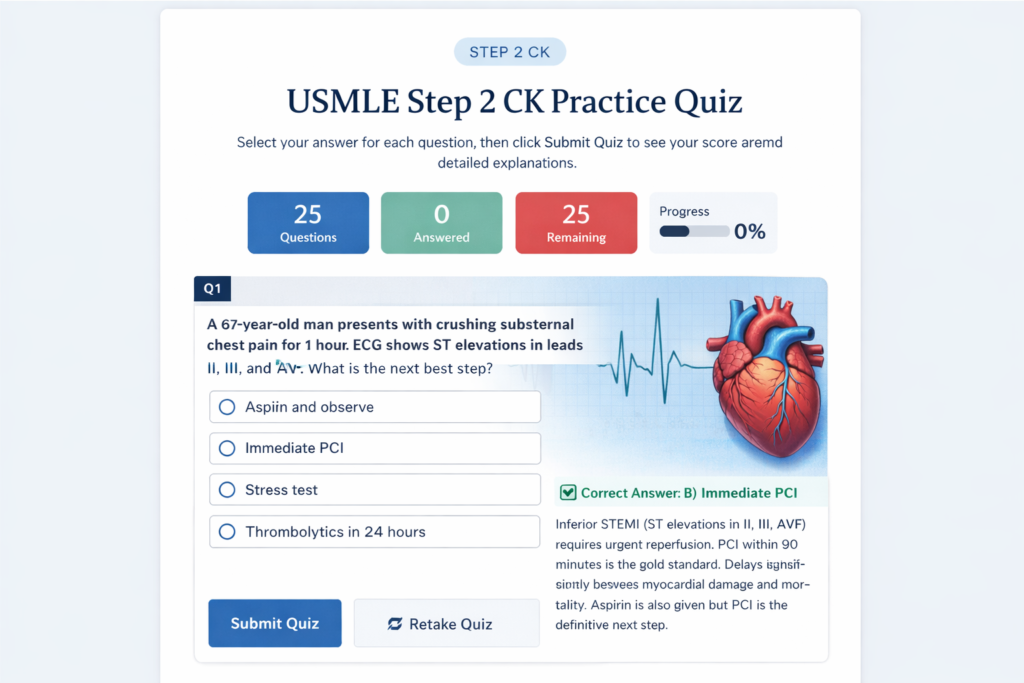
Select your answer for each question, then click Submit Quiz to see your score and detailed explanations.
25Questions
0Answered
25Remaining
Progress0%
Q1
A 67-year-old man presents with crushing substernal chest pain for 1 hour. ECG shows ST elevations in leads II, III, and aVF. What is the next best step?
✅ Correct Answer: B) Immediate PCI
Inferior STEMI (ST elevations in II, III, aVF) requires urgent reperfusion. PCI within 90 minutes is the gold standard. Delays significantly increase myocardial damage and mortality. Aspirin is also given but PCI is the definitive next step.
Q2
A 24-year-old woman presents with fever, dysuria, flank pain, and CVA tenderness. What is the most likely diagnosis?
✅ Correct Answer: B) Pyelonephritis
The triad of fever + flank pain + CVA tenderness strongly indicates ascending bacterial infection involving the kidney. Cystitis stays in the bladder and does not cause fever or CVA tenderness.
Q3
A patient with atrial fibrillation is hemodynamically unstable. BP is 80/50 mmHg. What is the next best step?
✅ Correct Answer: B) Synchronized cardioversion
Any hemodynamically unstable arrhythmia requires immediate synchronized electrical cardioversion. Do not delay for medications. A BP of 80/50 is shock — act immediately.
Q4
What is the most common cause of secondary hypertension?
✅ Correct Answer: A) Renal artery stenosis
Renovascular hypertension due to renal artery stenosis is the most common identifiable cause of secondary hypertension, especially in older adults with atherosclerosis or in young women with fibromuscular dysplasia.
Q5
A pregnant woman at 34 weeks has BP 165/110 mmHg and proteinuria. What is the first-line management?
✅ Correct Answer: B) Magnesium sulfate
This presentation is severe preeclampsia. First-line management includes IV magnesium sulfate for seizure prophylaxis along with antihypertensives (labetalol or hydralazine) and evaluation for delivery.
Q6
A 58-year-old man with a history of alcohol use presents with hematemesis. He is hypotensive and tachycardic. What is the first step in management?
✅ Correct Answer: B) IV fluids and blood transfusion
Hemodynamically unstable GI bleed requires immediate resuscitation with IV fluids and blood products before diagnostic endoscopy.
Q7
A child presents with barking cough and inspiratory stridor that improves with humidified air. Most likely diagnosis?
✅ Correct Answer: B) Croup
Barking cough + inspiratory stridor in a child is classic for viral croup (laryngotracheobronchitis). It responds to cool/humidified air and steroids.
Q8
A postpartum woman develops unilateral breast pain, fever, and erythema. Most appropriate treatment?
✅ Correct Answer: B) Dicloxacillin
Lactational mastitis is treated with anti-staphylococcal antibiotics such as dicloxacillin. Breastfeeding should continue during treatment.
Q9
A 70-year-old man presents with sudden painless vision loss in one eye. Fundoscopy shows a cherry-red spot. Diagnosis?
✅ Correct Answer: B) Central retinal artery occlusion
Sudden painless monocular vision loss with a cherry-red spot on a pale retina is the hallmark of CRAO — a true ocular emergency.
Q10
A patient with DVT is started on heparin. Platelets drop by 60% after 6 days. Next step?
✅ Correct Answer: B) Stop heparin and start argatroban
Heparin-induced thrombocytopenia (HIT) requires immediate discontinuation of all heparin products and initiation of a non-heparin anticoagulant such as argatroban or bivalirudin.
Q11
A 45-year-old woman presents with right upper quadrant pain, fever, and jaundice. What is the most likely diagnosis?
✅ Correct Answer: B) Acute cholangitis
Fever + jaundice + RUQ pain = Charcot triad, classic for ascending cholangitis. This is a medical emergency requiring IV antibiotics and urgent ERCP.
Q12
A 30-year-old woman presents with palpitations, heat intolerance, and weight loss. TSH is low. Next best test?
✅ Correct Answer: B) Radioactive iodine uptake scan
After confirming hyperthyroidism (low TSH, elevated T3/T4), the next step is determining the cause via RAIU scan to differentiate Graves disease from toxic adenoma or thyroiditis.
Q13
A 6-year-old boy has knee pain and a limp after a recent viral illness. Most likely diagnosis?
✅ Correct Answer: B) Transient synovitis
Hip pain and limp following viral infection with mild symptoms and low-grade or no fever suggests transient synovitis. Septic arthritis would present with high fever and inability to bear weight.
Q14
A patient with asthma presents with severe wheezing and inability to speak full sentences. Next step?
✅ Correct Answer: B) Inhaled albuterol + oxygen
Acute severe asthma requires immediate bronchodilation with short-acting beta-2 agonists and supplemental oxygen. Systemic steroids are added but albuterol is the first priority.
Q15
A 72-year-old man has progressive difficulty urinating and weak stream. Most likely cause?
✅ Correct Answer: B) Benign prostatic hyperplasia
Gradual onset urinary hesitancy, weak stream, and nocturia in older men is the classic presentation of BPH — the most common cause of obstructive voiding symptoms in elderly males.
Q16
A patient presents with sudden “worst headache of life” and nuchal rigidity. Best initial test?
✅ Correct Answer: B) CT scan without contrast
Sudden “thunderclap” headache requires immediate noncontrast CT head to detect subarachnoid hemorrhage. LP follows if CT is negative.
Q17
A sexually active woman presents with lower abdominal pain and cervical motion tenderness. Diagnosis?
✅ Correct Answer: B) Pelvic inflammatory disease
Cervical motion tenderness (“chandelier sign”) with adnexal tenderness in a sexually active woman is classic for PID. Treat empirically with broad-spectrum antibiotics.
Q18
Most common cause of acute pancreatitis in the United States?
✅ Correct Answer: B) Gallstones
Gallstones account for approximately 40–70% of acute pancreatitis cases in the US. Alcohol is the second most common cause. Remember: “GET SMASHED” mnemonic for causes.
Q19
A depressed patient reports suicidal ideation with a specific plan. Best next step?
✅ Correct Answer: C) Immediate hospitalization
Suicidal ideation with a specific plan is a psychiatric emergency requiring inpatient admission for safety monitoring and stabilization.
Q20
A newborn has bilious vomiting and abdominal distension. Most likely diagnosis?
✅ Correct Answer: B) Duodenal atresia
Bilious vomiting in a neonate suggests obstruction distal to the ampulla of Vater. Pyloric stenosis causes nonbilious vomiting at 2–8 weeks. X-ray of duodenal atresia shows the classic “double bubble” sign.
Q21
First-line treatment for acute symptom relief in stable angina?
✅ Correct Answer: A) Sublingual nitroglycerin
Sublingual nitroglycerin is the mainstay for acute relief of stable angina episodes due to its rapid vasodilatory effect, reducing preload and myocardial oxygen demand.
Q22
A patient presents with painful red eye, halos around lights, and a fixed mid-dilated pupil. Diagnosis?
✅ Correct Answer: B) Acute angle-closure glaucoma
Painful red eye with fixed mid-dilated pupil, halos, and sudden vision loss is classic for acute angle-closure glaucoma. Treat urgently with topical beta blockers, alpha agonists, and acetazolamide.
Q23
Most common cause of community-acquired pneumonia in adults?
✅ Correct Answer: B) Streptococcus pneumoniae
S. pneumoniae remains the most common bacterial cause of CAP in adults. It presents with productive cough, fever, rusty sputum, and lobar consolidation on CXR.
Q24
A patient presents with sudden-onset tearing chest pain radiating to the back, with unequal arm blood pressures. Diagnosis?
✅ Correct Answer: B) Aortic dissection
Tearing/ripping chest pain radiating to the back with unequal blood pressures or pulses is the hallmark of aortic dissection. Immediately obtain CT angiography. Do not give thrombolytics.
Q25
Current USPSTF recommendation for colorectal cancer screening in average-risk adults?
✅ Correct Answer: B) Begin at age 45
Current U.S. guidelines (USPSTF 2021) recommend starting colorectal cancer screening at age 45 for average-risk adults, updated from the previous threshold of 50.
Are these USMLE Step 2 CK questions similar to the real exam?
Yes. These questions follow NBME clinical vignette style, emphasizing diagnosis, management, and patient safety — exactly how Step 2 CK is tested.
Are these USMLE Step 2 CK questions free?
Yes. This is a completely free Step 2 CK practice quiz with answers and explanations, designed for self-assessment.
How many questions should I practice daily for Step 2 CK?
Most students benefit from 40–80 questions per day, with thorough review of explanations.
These questions are created for U.S. and international medical graduates preparing for the USMLE Step 2 CK and reflect NBME exam patterns and current clinical guidelines.